Let me be honest with you: eggplant has a reputation for being fussy, and for a while, I believed it. My first attempt — a lonely row of Black Beauties in a raised bed — gave me pale, pockmarked fruit and a beetle problem that refused to quit. The second year, I tried something different. I planted with intention. I gave those eggplants neighbours. And the difference was almost embarrassing.
If your eggplant crop has ever disappointed you, there’s a good chance it wasn’t the variety, the weather, or bad luck. It was isolation. Eggplant is a heavy feeder, a pest magnet, and a heat lover — three things that companion planting addresses beautifully when you get the combinations right.
This guide covers the best companion plants for eggplant in a raised bed: what to grow right alongside it, what to keep on the other side of the garden, and the practical spacing that makes it all work in a confined space.
Why companion planting matters more in a raised bed
Raised beds concentrate everything — nutrients, heat, moisture, and unfortunately, pests. When flea beetles or spider mites find your eggplant in an in-ground garden, there’s a chance they’re spread across a large area. In a raised bed, they’re packed in tight with everything they need. The stakes are higher.
But that same concentration works in your favour with companion planting. You’re creating a dense, layered ecosystem in a small space — scent barriers, insect habitat, nitrogen replenishment, and ground cover all within arm’s reach of your eggplant roots. Done well, a raised bed is actually the best place to practise companion planting because the interactions happen in close quarters and the results show up fast.
The best companion plants for eggplant in a raised bed
🌿 Basil — the eggplant’s best friend
Ask any experienced kitchen gardener what to grow next to eggplant and they’ll say basil without hesitation. This isn’t folklore — there’s real mechanism behind it. The volatile oils in basil leaves, particularly estragole and linalool, are genuinely repellent to aphids, spider mites, and whiteflies. Plant it close: 20–25 cm from the eggplant stem, tucked between plants rather than on the border.
There’s a practical bonus too. Eggplant and basil are culinary soulmates — you’re going to be picking them together anyway. Having them in the same bed means one trip to the garden for an entire meal’s worth of ingredients.
Go for large-leaf Genovese or Napoletano basil for maximum volatile oil coverage. Pinch the flowers regularly so the plant keeps producing aromatic leaves rather than going to seed.
🌸 Marigolds — the perimeter defenders
French marigolds (Tagetes patula) are the most reliably useful plant you can grow around any Solanaceae crop. They deter a wide range of insects through both scent and root exudates — the chemical compounds their roots release into the soil have been shown to suppress nematodes over time. For eggplant, which is particularly susceptible to root-knot nematodes in warm, sandy soil, this matters.
Plant them densely along the border of your raised bed — one plant every 20 cm around the entire perimeter. The yellow and orange flowers also attract hoverflies and parasitic wasps, which prey on the aphids and caterpillars that would otherwise make a meal of your eggplant foliage.
One thing to know: for the nematode suppression to work, marigolds need to be grown in the same soil for a full season and ideally dug back in at the end of it. One season of perimeter marigolds won’t fix a nematode problem, but it will prevent one from starting.
🪲 Nasturtiums — the trap crop trick
Nasturtiums are the sacrificial companion of the garden world, and that’s a compliment. Aphids love nasturtiums. They love them more than they love eggplant. So when you plant nasturtiums at the edges of your raised bed, you’re essentially offering aphids a better option — one you don’t mind them colonising.
This is called a trap crop, and it works reliably. Check your nasturtiums every few days; when aphid populations build up, cut off the affected stems and drop them in a bucket of soapy water. The flowers are edible, the leaves make a peppery addition to salads, and the whole plant is expendable. Let it trail over the sides of the bed so it doesn’t compete aggressively with the eggplant roots.
🌱 Spinach and lettuce — the living mulch layer
One of the underrated challenges with raised-bed eggplant is soil temperature management. Eggplant loves heat at the root zone but exposed soil can dry out and bake rapidly in full sun, stressing the plant mid-season. Low-growing leafy greens planted between eggplant stems solve this elegantly.
Spinach and loose-leaf lettuce form a natural living mulch — their canopy shades the soil, holds moisture, and keeps the microbiome cooler and more active. They’re also fast-growing and can be harvested and eaten long before the eggplant needs that space in midsummer. Think of them as a short-season companion that earns its place before bowing out.
Interplant them between eggplant at transplant time. By the time your eggplant hits full canopy spread, the lettuce will have been harvested and the soil will be better for having had them there.
🫘 Bush beans — nitrogen on tap
Eggplant is a heavy feeder — it pulls nitrogen from the soil steadily through the growing season. Bush beans are legumes, which means they do the opposite: they fix atmospheric nitrogen through root bacteria and make it available to neighbouring plants. In a raised bed, planting a row of bush beans alongside eggplant means your soil is being slowly replenished even as the eggplant draws it down.
Use bush beans rather than pole beans here — pole beans will compete for vertical space and potentially shade the eggplant. Bush varieties stay compact, don’t climb, and fit neatly into the margins of a raised bed without crowding. Keep them 30–40 cm from the eggplant stems to avoid root competition.
🌼 Borage — the pollinator magnet
Eggplant needs pollinators to set fruit — it’s self-fertile but benefits enormously from bee vibration (called buzz pollination) to shake pollen loose from the flower anthers. Borage produces a continuous flush of star-shaped blue flowers that bees find irresistible, drawing them into the bed and increasing pollinator visits to your eggplant flowers significantly.
Plant one borage plant at a corner of the raised bed — it grows large and somewhat sprawling, so one is usually enough for a standard 4×4 bed. It also self-seeds prolifically, which is either a feature or a bug depending on how you feel about volunteers in next year’s garden.
🧅 Chives and garlic — the quiet defenders
Members of the allium family planted along the border of a raised bed act as a continuous aromatic barrier. Their sulphur compounds confuse and deter aphids, spider mites, and Japanese beetles — all of which have eggplant on their preferred host list. Chives are perennial in most climates, meaning once planted they come back year after year with no effort from you.
Garlic planted in autumn to overwinter and harvested in early summer is especially useful: it occupies border space during the off-season, deters overwintering pests, and is harvested just as the eggplant transplants go in — perfect timing with no spacing conflict.
🌻 Sunflowers — the tall sentinel
Planted at the northern end of your raised bed (so they don’t shade the eggplant), sunflowers provide several benefits at once. Their tall stalks attract predatory insects, their flowers bring pollinators into the garden, and their deep taproots draw up minerals from the subsoil that shallower plants can’t access. When the stalks are cut at season’s end and left to decompose, those minerals return to the raised bed’s topsoil.
Choose a medium-height variety — Lemon Queen or Velvet Queen sit at 1.2–1.5 m and won’t cast excessive shade. One or two plants at the back edge of the bed is all you need.
Also Read: 11 Best Companion Plants for Yarrow
Spacing guide for eggplant companions in a raised bed
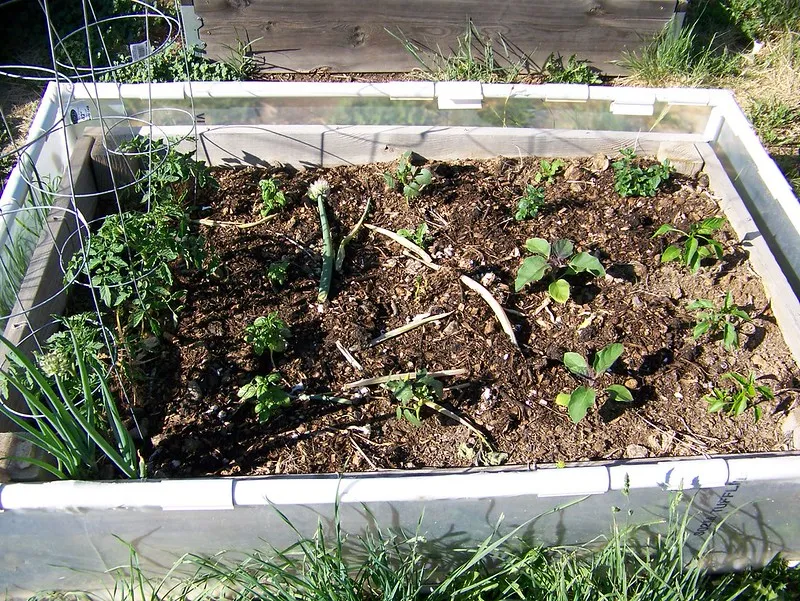
In a typical 4×4 or 4×8 raised bed, eggplant is usually grown 45–60 cm apart in each direction — that gives you four plants in a 4×4 bed or eight in a 4×8. The companion plants fill in around them. Here’s a practical reference for positioning.
| Companion Plant | Position in Bed | Distance from Eggplant | When to Plant |
|---|---|---|---|
| Basil | Between plants, throughout the bed | 20–25 cm | Same time as eggplant transplants |
| French marigolds | All around the perimeter | Border of bed | 2–3 weeks before eggplant |
| Nasturtiums | Corners and edges, trailing over sides | Perimeter | Same time or slightly after |
| Spinach / lettuce | Between eggplant stems | 20–30 cm | 4–6 weeks before eggplant (harvest before eggplant fills out) |
| Bush beans | One edge of the bed | 30–40 cm | Same time as eggplant |
| Borage | One corner of the bed | 45–60 cm (it spreads) | Direct sow 2–3 weeks before last frost |
| Chives | Along the border | Perimeter | Perennial — plant once, permanent |
| Garlic | Along the border | Perimeter | Autumn planting, harvested by eggplant transplant time |
| Sunflowers | North/shaded end of bed only | 50–60 cm | Direct sow 1–2 weeks after last frost |
Always plant eggplant in full sun — at least 6–8 hours daily. When planning companions, make sure taller plants (sunflowers, borage) go at the north end of the bed so they shade the soil without blocking sun from the eggplant canopy.
Plants to keep away from eggplant
Companion planting has two sides: the allies, and the plants that actively work against your crop. These are the ones to keep well away from your eggplant bed.
Other Solanaceae: tomatoes, peppers, and potatoes
Eggplant is a member of the nightshade family, just like tomatoes, peppers, and potatoes. Plants in the same family share the same pests and diseases — early blight, Verticillium wilt, flea beetles, and aphid species among them. Growing nightshades together concentrates both the risk and the damage. If one plant gets hit, the others will follow quickly.
More critically, planting nightshades in the same raised bed year after year depletes the same soil nutrients and allows disease spores to build up in the soil. Rotate your nightshades across different beds on a three-year cycle at minimum.
Fennel
Fennel is allelopathic — it releases compounds from its roots that inhibit the growth of most vegetables nearby, including eggplant. It’s best grown in a container or a dedicated corner of the garden well away from your raised beds. It’s not that fennel is a bad plant; it’s just a difficult neighbour for almost everything.
Corn
Corn is a towering, heavy feeder that will compete aggressively with eggplant for both space and nitrogen. It also shades quickly and unpredictably as it grows — you might think you’ve planted it far enough away, and then by midsummer it’s casting shade across half the bed. Keep corn in its own dedicated space.
Brassicas (cabbage, broccoli, kale, cauliflower)
Brassicas and eggplant have incompatible growing conditions — brassicas prefer cooler temperatures and less aggressive feeding schedules. More practically, brassicas attract the same aphid and whitefly species as eggplant when grown nearby, doubling the pest pressure in a concentrated area. Keep them in separate beds.
What all of this does for your eggplant — the real picture
Let’s be concrete. A well-planted eggplant raised bed — marigolds on the perimeter, basil between the plants, nasturtiums trailing at the corners, a borage plant drawing in bees, and a row of bush beans on one edge — is doing several things simultaneously that a lonely eggplant monoculture simply can’t.
- Pest confusion: The mixture of scents from basil, marigold, and alliums disrupts the chemical signals aphids and beetles use to locate host plants. A pest that can smell eggplant clearly will land on it; one that has to navigate a fog of competing volatiles may not bother.
- Predator habitat: Flowering companions like borage, marigold, and dill provide nectar and shelter for predatory insects — hoverflies, lacewings, parasitic wasps — that keep pest populations below damaging levels without any intervention from you.
- Soil replenishment: Bush beans and clover quietly top up nitrogen even as the eggplant draws it down. You’ll use less fertiliser over the season and leave the bed in better condition for the following year.
- Moisture retention: Low-growing companions between eggplant stems shade the soil and slow moisture evaporation — especially important in a raised bed that dries out faster than in-ground soil.
- Better pollination: More pollinators in the bed means more buzz pollination on eggplant flowers, which means more fruit set per plant. The difference between a well-visited eggplant and a neglected one is genuinely visible at harvest.
A few practical notes from the garden
Don’t crowd the eggplant itself
All the companions in the world won’t help if the eggplant is stressed by overcrowding. The plant needs good airflow through its canopy to prevent fungal issues — particularly grey mould and powdery mildew in humid conditions. Give each plant at least 45 cm of space in each direction, and don’t plant companions so aggressively that they press against the eggplant stems. Companions go around the eggplant, not on top of it.
Flea beetles are your biggest enemy — here’s the companion response
If you grow eggplant, you will eventually deal with flea beetles. These tiny, jumping insects shotgun-hole eggplant leaves with impressive speed and can stress young transplants badly. The companion strategy for flea beetles is layered: basil and catnip both repel them; nasturtiums act as a sacrificial trap; and if you want a dedicated flea beetle barrier, consider adding a few stems of catnip (Nepeta cataria) at the bed’s corners. Catnip is one of the more specific flea beetle deterrents and takes up very little space.
Companion timing is as important as companion choice
The best companion plant in the wrong season is just a plant that’s in the way. Get marigolds started indoors three to four weeks before your last frost so they’re already flowering when you transplant eggplant. Sow nasturtiums directly at transplant time — they germinate fast. Have the basil ready to go in the ground at the same time as the eggplant. The point is a complete, functional ecosystem from day one, not a patchwork that comes together weeks later when pests have already moved in.
Eggplant transplants are vulnerable for the first two to three weeks after going into the ground. That’s when flea beetles and aphids do the most damage. Your companions need to be in place before the eggplant goes in — not after.
The bed that looks after itself
What I’ve found, after a few seasons of companion-planted eggplant beds, is that the goal isn’t to eliminate every pest or grow perfect fruit. It’s to create a bed that has enough natural resilience that you’re not constantly intervening. A marigold border, some basil between the plants, nasturtiums at the corners, and one borage plant humming with bees — that’s not a complicated system. It’s a ten-minute planting decision that pays dividends for the whole growing season.
Your eggplant doesn’t want to be alone. Give it the right neighbours and it’ll show you what it’s actually capable of.
The best gardens are the ones where every plant is doing someone else a favour. 🍆