If you’ve ever grown strawberries in a raised bed and still ended up with half-eaten berries, spotty harvests, or plants that look… sad — this one’s for you.
The truth is, strawberries are a bit needy. They want good drainage, steady moisture, full sun, and protection from a surprisingly long list of pests. Growing them in a raised bed already gives them a head start. But pairing them with the right neighbors? That’s where things get genuinely interesting.
Companion planting isn’t some old wives’ tale. It’s practical, low-effort, and when done well, it means fewer pests, better pollination, and more berries — without reaching for a single bottle of spray. Let’s get into it.
Why Companion Planting Works So Well in a Raised Bed
A raised bed is essentially a controlled ecosystem. You’ve got limited space, which means every plant you put in there should earn its spot. The good news is that companion plants can pull a lot of weight — repelling pests, attracting the right pollinators, suppressing weeds, and even improving soil health.
Strawberry flowers are small and self-fertile, but they depend heavily on insect visits for a full fruit set. Research from the University of Minnesota found that hoverflies and native sweat bees — not honeybees — are actually the primary visitors to strawberry flowers. Growing plants that attract this broader range of insects can make a real difference in berry size and yield.
On the pest side, strawberries are magnets for aphids, slugs, spider mites, and root-knot nematodes. Many companion plants disrupt pests passively — through scent, root compounds, or by hosting predatory insects — so you’re not constantly playing defense.
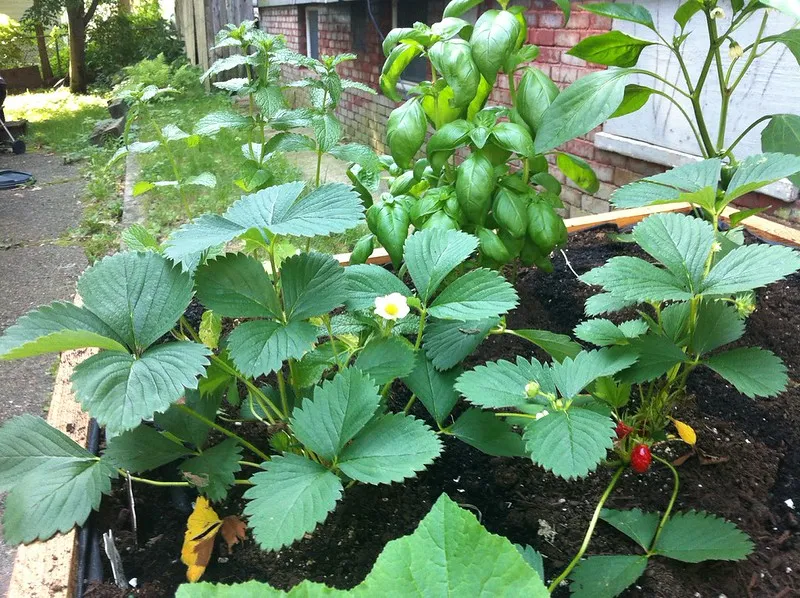
The Best Plants to Grow With Strawberries in a Raised Bed
1. Borage
If you only add one companion plant to your strawberry bed, make it borage. It’s beautiful, it’s useful, and it has a long-standing reputation as the ultimate strawberry companion.
The bright blue star-shaped flowers are absolutely irresistible to bees and pollinators, which means more and better-formed berries. Borage also repels tomato hornworms and cabbage worms, and many gardeners swear it actually improves the flavour of nearby strawberries — though that part is harder to prove scientifically.
Plant one or two borage plants at the corners of your raised bed. It can get big (up to 2–3 feet), so keep that in mind — but you can chop the leaves and use them as a mulch around your strawberry crowns.
2. Chives
Chives are one of the tidiest companions you can grow alongside strawberries. They grow upright rather than sprawling, so they won’t compete for horizontal space — which matters a lot in a raised bed.
They’re part of the allium family, which means they release sulfur-based compounds that confuse and deter aphids, slugs, and mites. Some gardeners also claim chives enhance the flavour of neighbouring strawberries. Whether that’s true or not, they’re a low-maintenance perennial that comes back every year without any fuss. Plant them between strawberry clumps every two or three plants.
3. Thyme (Especially Creeping Thyme)
Thyme is one of those herbs that works hard in a garden. When it flowers, it draws in pollinators — and crucially, it also attracts hoverflies, whose larvae feed on aphids. That makes it both a pollinator magnet and a pest control plant in one.
Creeping thyme is especially useful in a raised bed because it stays low and dense, acting almost like a living mulch along the inner edges of the bed. It suppresses weeds, helps retain moisture, and doesn’t compete with your strawberries for nutrients. It’s a quiet workhorse that does its job without taking up much space at all.
4. Marigolds (French Marigolds Specifically)
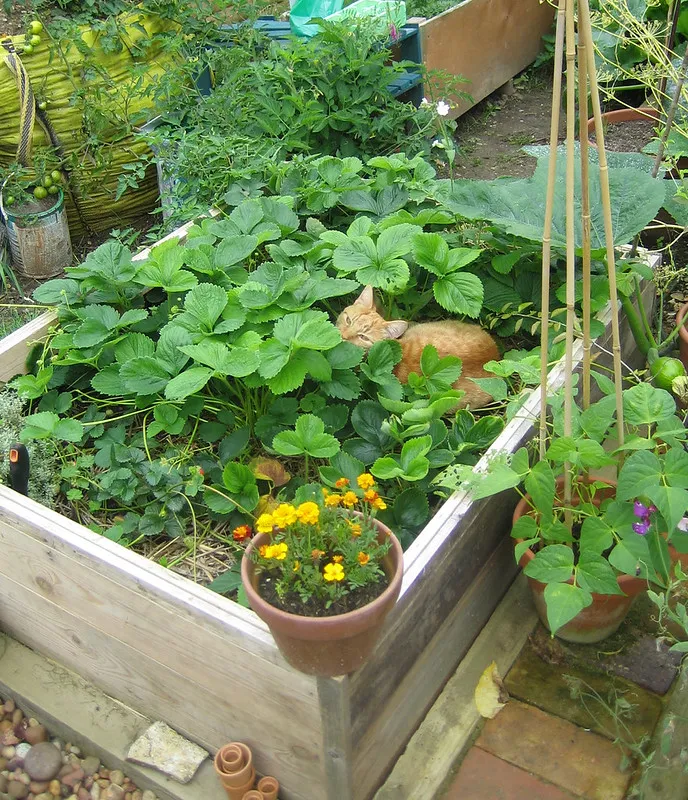
French marigolds might be the most useful flower in the vegetable garden, and strawberry beds are no exception. Their roots produce a natural compound that spreads into surrounding soil and actively repels root-knot nematodes — one of the most destructive pests for strawberries, capable of stunting and killing plants from beneath the soil.
Above ground, the flowers repel whiteflies and even keep rabbits at a distance. Plant them around the four corners of the bed or interplant one every 3–4 feet between strawberry rows. They’re compact, cheerful, and frankly just make the whole bed look better.
5. Garlic
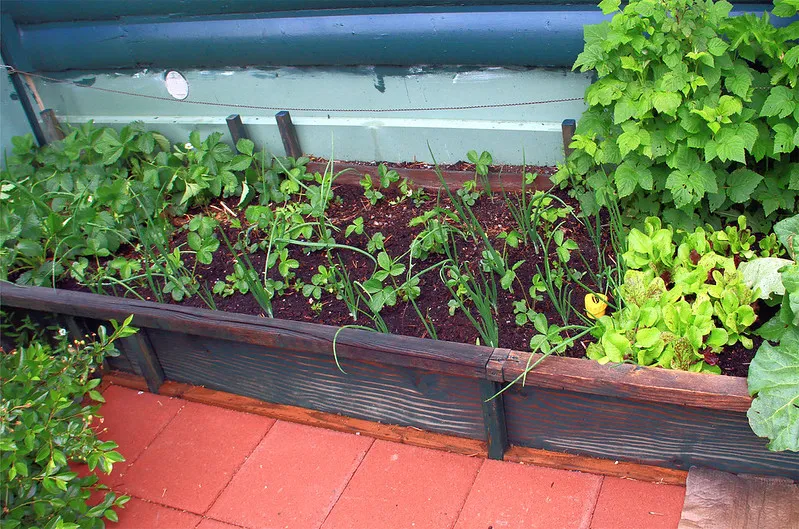
Garlic is one of the most reliable pest deterrents in the garden. The strong scent confuses and repels aphids, slugs, and spider mites that are drawn to strawberry plants. It takes up very little space — one clove becomes one plant — and can be tucked in along the edges of a raised bed without crowding anything out.
The only thing to keep in mind: when you harvest garlic, you’ll need to dig it up, which can disturb nearby strawberry roots if they’re planted too close together. Give each garlic plant a little breathing room from the strawberry crowns.
6. Spinach
This one is more about space efficiency than pest control. Spinach is a shallow-rooted, cool-season crop that grows quickly in spring — right before your strawberries hit peak productivity. It acts as a living mulch, covering bare soil, suppressing weeds, and keeping moisture in without competing with your strawberries for nutrients.
By the time your strawberries start taking over the bed, the spinach will be ready to harvest and clear out. It’s a nice, tidy succession that uses every inch of your raised bed through spring.
7. Bush Beans
Strawberries are heavy feeders, and nitrogen is one nutrient they always want more of. Bush beans are legumes, which means they fix atmospheric nitrogen in the soil through their root nodules — essentially adding free fertiliser to your bed as they grow.
Bush beans (not climbing varieties) are compact enough to share raised bed space without shading out strawberries. They’re particularly useful if you’re growing your strawberries in a new raised bed with soil that’s still building up its fertility.
8. Yarrow
Yarrow is a brilliant multipurpose companion that doesn’t get nearly enough credit. The flowers attract an impressive range of beneficial insects — ladybugs, lacewings, hoverflies, and predatory wasps — all of which feed on or parasitise common strawberry pests like aphids and mites.
It stays relatively compact and low, so it’s not going to shade out your strawberries. As a bonus, yarrow makes a lovely cut flower, and the dried blossoms have a surprisingly sweet, honey-like scent. Plant it along the edges of the bed or between rows for best effect.
Also Read: Companion Planting with Lemongrass: Best Plants to Grow Together
A Simple Layout That Actually Works
If you’re planning your raised bed from scratch, here’s a layout that works well for a standard 4×8 ft bed:
- Centre: Two offset rows of strawberries, 12–18 inches apart in a zigzag pattern for airflow.
- Between plants: Small clumps of chives or creeping thyme tucked between every two or three strawberry plants.
- Bed edges: A ribbon of marigolds and yarrow along the long sides.
- Corners: One borage plant per corner — they’re big enough to anchor the space and easy to reach for occasional leaf-mulching.
This layout keeps airflow strong, maximises pollinator access to the strawberry flowers, and creates a layered pest barrier around the whole bed.
What NOT to Plant With Strawberries
Just as important as knowing what to grow nearby is knowing what to keep away. A few plants are genuinely problematic neighbours:
- Brassicas (cabbage, broccoli, kale): These are heavy feeders that will compete aggressively with strawberries for nutrients and space.
- Fennel: One of the few plants that is allelopathic — it releases compounds that inhibit the growth of many other plants, including strawberries.
- Nightshades (tomatoes, peppers, eggplant): These are hosts for Verticillium wilt, a soil-borne fungal disease that also attacks strawberries. If any of these were grown in the same bed recently, give it a few years before introducing strawberries.
- Mint: Mint spreads aggressively through underground runners and can quickly take over a raised bed, crowding out your strawberries entirely. If you want mint nearby, keep it in a container.
Final Thoughts
Companion planting a raised strawberry bed isn’t complicated — it just takes a little planning upfront. The right neighbours will quietly do their jobs all season: deterring pests, feeding the soil, attracting pollinators, and filling in bare soil so weeds don’t get a foothold.
Start simple. Add borage, chives, and a few French marigolds if nothing else. See how your strawberries respond. Once you notice the difference — fuller fruit, fewer pest problems, a bed that just feels alive — you’ll never go back to planting strawberries alone again.
Have a companion planting combination that’s worked brilliantly for you? Drop it in the comments — I’d genuinely love to hear what’s growing in your raised beds.
Also Read: The Best Companion Plants for Corn in a Raised Bed